
When you build a house, concrete plays an important role in its strength and durability. Builders use concrete for foundations, columns, beams and slabs.
During construction, you may hear terms like M20 and M25 concrete. But what do these grades mean? What makes them different? Which concrete grade should you choose for your house?
In this blog, let’s understand the difference between M20 and M25 concrete, their strength, uses and important features.
What Is M20 Concrete?
M20 is a common concrete grade used in building construction.
The letter ‘M’ stands for Mix, and the number 20 represents its characteristic compressive strength.
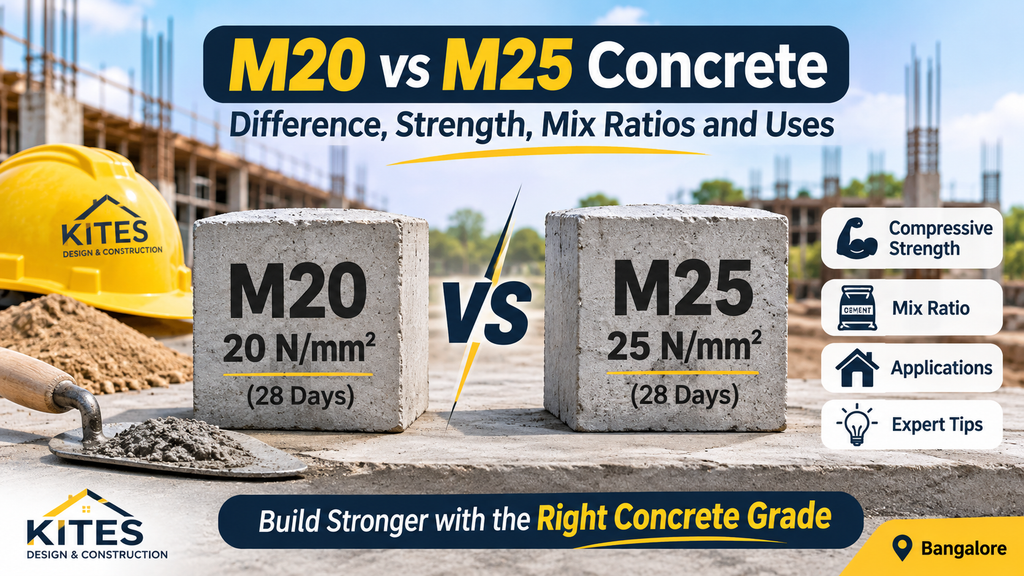
M20 concrete has a characteristic compressive strength of 20 N/mm² after 28 days of curing.
Builders and engineers use this grade for different construction works, depending on the structural design.
A commonly used nominal mix ratio for M20 concrete is 1:1.5:3.
This means:
- 1 part cement
- 1.5 parts sand
- 3 parts coarse aggregate
However, engineers should check the material quality and project requirements before choosing the mix.
What Is M25 Concrete?
M25 is another concrete grade used in residential and commercial construction.
The number 25 represents its characteristic compressive strength of 25 N/mm² after 28 days of curing.
M25 offers higher specified compressive strength than M20 concrete.
Engineers generally use a design mix for M25 concrete. They calculate the correct proportions of cement, sand, aggregates and water based on the required strength and workability.
This process helps them achieve the required concrete quality.
Difference Between M20 and M25 Concrete
The main difference between M20 and M25 concrete is their compressive strength.
Let’s compare both grades.
| Features | M20 Concrete | M25 Concrete |
|---|---|---|
| Concrete grade | M20 | M25 |
| Compressive strength | 20 N/mm² | 25 N/mm² |
| Testing age | 28 days | 28 days |
| Grade category | Ordinary grade | Standard grade |
| Mix type | Nominal or design mix | Design mix |
| Strength level | Lower | Higher |
| Mix proportion | 1:1.5:3 for nominal mix | Based on mix design |
M25 concrete offers 25% higher specified characteristic compressive strength than M20.
However, the right concrete grade depends on the structural design and site conditions.
1. Difference in Compressive Strength
Compressive strength tells us how much pressure concrete can withstand before it fails.
M20 concrete has a characteristic compressive strength of 20 N/mm². M25 concrete has a strength of 25 N/mm².
Engineers check these values through concrete cube tests.
They collect fresh concrete samples, prepare test cubes and test them after the required curing period.
This process helps engineers check whether the concrete meets the required strength.
2. Difference in Concrete Mix Ratio
Concrete contains four main materials:
- Cement
- Fine aggregate (sand)
- Coarse aggregate
- Water
The quantity of each material affects the final concrete strength.
For M20 nominal mix concrete, builders commonly use a 1:1.5:3 ratio.
But M25 concrete needs a proper mix design. Engineers calculate the material quantities based on the required strength, water-cement ratio and workability.
A correct mix helps maintain concrete quality throughout the construction process.
3. Uses of M20 and M25 Concrete
Both concrete grades have different applications. Engineers select the grade based on structural requirements.
Common Uses of M20 Concrete
- Residential RCC construction where the design permits M20.
- Certain foundation works.
- Beams and slabs where the structural design specifies M20.
- Other general construction applications.
Common Uses of M25 Concrete
- Residential building structures.
- RCC beams and columns.
- Structural slabs.
- Commercial building structures.
- Projects that require higher specified concrete strength.
Remember, builders should never select concrete grades only by looking at the building height or construction type. A structural engineer must check the loads, soil conditions and design requirements.
4. Why Does Concrete Grade Matter in House Construction?
Concrete grade plays an important role in building construction.
Here are four reasons why it matters.
Structural Strength
The correct concrete grade helps the building withstand the loads that act on its structural members.
Building Durability
A good concrete mix helps protect the structure from early damage. Proper curing also improves concrete performance.
Construction Quality
Engineers check the concrete grade through regular testing. This helps them maintain the required construction standards.
Structural Safety
The correct concrete grade supports the structural design. It also helps engineers achieve the required strength and durability.
5. How Do Engineers Test Concrete Strength?
Concrete cube testing helps engineers check the compressive strength of concrete.
Here is how the process works:
- Workers collect fresh concrete samples from the construction site.
- They fill standard cube moulds with concrete.
- They compact the concrete properly to remove air gaps.
- They keep the cubes in a curing tank under controlled conditions.
- They test the cubes using a compression testing machine.
- Engineers record the results and compare them with the required strength.
Engineers commonly test concrete cubes at 7 days and 28 days.
The 28-day test helps them check whether the concrete has achieved its specified characteristic strength.
Which Is Better: M20 or M25 Concrete?
M25 concrete has higher specified compressive strength than M20. But that does not mean M25 suits every construction project.
The right choice depends on several factors:
- Building design
- Number of floors
- Structural load
- Soil conditions
- Environmental exposure
- Durability requirements
- Structural engineer’s recommendations
For example, a house may need different concrete grades for different structural components.
Therefore, always follow the structural drawings and recommendations of a qualified structural engineer.
Do not choose a higher concrete grade simply because you think it will make the entire building stronger.
Frequently Asked Questions About M20 and M25 Concrete
1. What is the main difference between M20 and M25 concrete?
M20 has a characteristic compressive strength of 20 N/mm², while M25 has 25 N/mm² after 28 days of curing.
2. Is M25 stronger than M20 concrete?
Yes. M25 has 25% higher specified characteristic compressive strength than M20.
3. What is the M20 concrete mix ratio?
The commonly used nominal mix ratio for M20 concrete is 1:1.5:3. However, the engineer must consider material quality and project requirements.
4. Does M25 concrete need a mix design?
Yes. M25 is a design-mix grade. Engineers calculate the material proportions to achieve the required strength and workability.
5. Can we use M20 concrete for house construction?
Yes. Engineers can specify M20 for suitable structural applications, provided it meets the applicable design and exposure requirements.
6. How many days does concrete take to gain strength?
Engineers use 28-day compressive strength to classify concrete grades. Concrete continues to gain strength beyond 28 days under suitable conditions.
7. How do we check concrete quality at a construction site?
Engineers check concrete quality through slump tests, cube tests, material checks and proper site inspections.
Conclusion
Understanding the difference between M20 and M25 concrete helps you make better decisions during house construction.
M20 provides a characteristic compressive strength of 20 N/mm², while M25 provides 25 N/mm².
Both grades have different applications. The structural engineer should select the correct grade based on the building design and construction requirements.
At Kites Design & Construction, we focus on proper planning, material selection and quality at every stage of construction.
Planning to build your dream home in Bangalore?
Contact Kites Design & Construction to discuss your construction requirements.
📞 Call/WhatsApp: +91 9945853999
🌐 Website: Kites Design Construction Official Website
Instagram : kitesconstruction
Youtube:https://youtube.com/@kiteskdc?si=svwFYZ10Pp2KHiOn
Facebook: https://www.facebook.com/profile.php?id=61576916831753